Thursday, September 21, 2023

Forgiveness

 Forgiveness 

Roz didn’t intend to go to church with Uncle Albert and me; she was only going to help us up the stairs, then she was going to get a cup of coffee and come back to help us back down. But when she realized how little time she was going to have for her coffee, and then when she ran into our rector, the former Miss Virginia, at the top of the stairs, she decided to stay: to help us down the aisle to our seats and to help us to the communion rail for the body and blood. And in the interim to listen to the Bible and the message.
     The Bible was about the story in Genesis (50),* where Joseph forgives his brothers because even though they intended him harm, God intended it for good, in order to save many, including them, the ill-intending brothers, and their little ones. And about Psalm 103 and the God that forgives all our iniquities and heals all our diseases because he doesn't deal with us according to our sins; rather as far as the east is from the west, so far he removes them from us. And it was about The Apostle’s letter to the Romans (14) where he asks them shy they pass judgment on one another? why do they despise one another? Don’t we all stand before “the judgment seat of God”? — which, haven't we just heard, is all-forgiving? And finally, the Bible was about the story in Matthew 18, where Peter comes to Jesus to ask how often he should forgive, and Jesus tells him 77 times. That is, if he doesn’t want to stand before God’s judgment, which.
     And the sermon was about forgiveness, the vocation above all other vocations for the follower of Jesus.

St. Jude’s
The rest followed: the creed and the peace and the pages and pages of prayers and the kneeling at the rail then trying to get up again after the priest, the former Miss Virginia, said the eucharist has ended, go home. (Except, I think, she said the Eucharist.)
     And we did get up and we got down the aisle and we got out the door and we got down the stairs, with Roz’s help. And into the car, and on the way home, Roz looked at Uncle Albert sitting beside her and over her shoulder at me in the backseat behind him and said, “Why do you think, since all over the world today the message must be about forgiveness, no one is very forgiving, if at all?” And after a minute, Uncle Albert asked her how many people she guessed were in worship that morning at St. Jude’s? And she shrugged. He said, “8.”

“She is right, you know,” Uncle Albert said at the half of the extremely boring, indeed unrelievedly tedious, Everton-Arsenal match. He looked over at me. I muted Rebecca Lowe and the one Robbie and Lee Dixon. I looked vacantly back, meaning she who? “Miss Virginia,” he said. “Not that the other she, Roz, is wrong. But when the last Christian dies, probably not too long from now, forgiveness will disappear from the planet, for we are the only people that have a true vocation for it.”
     “Oh?” I said, meaning “You really think so?”
     “I mean true forgiveness,” Uncle Albert said. “Everyone else wants justice though some will pay lip service to mercy. But mercy is not the same as forgiveness. Actually, you have to have that vocation for forgiveness to know how far away it is,” Uncle Albert said.

                                                                           09.21.23
_______________
 * The passages, from the common lectionary for the sixteenth Sunday after Pentecost (September 17, 2023) are here.

Thursday, September 14, 2023

More on being concise if you can't just shut up.

I am still on the topic of concision (See here.), re-running a post from April 0f 2020, during Covid. That is why in the post, Uncle Albert and I are going “to Easter service in a different state.” On Facebook or YouTube, randomly we went.

 Best Easter sermon ever. 

As we have been these last few weeks, Uncle Albert and I went to Easter service in a different state according to a different polity.
     Roz said she would be happy - “I really mean it,” she said, “happy” - to fix Easter dinner instead of watching with us though I had volunteered to make spaghetti.
     “What will you be cooking then?” Uncle Albert asked, pretending not to be pleased. He says he likes my spaghetti, but he always adds “okay.” “I like your spaghetti okay,” he says.
     “I don’t know,” Roz said. “I’ll have to look around. We’ll see.”
     “It’ll be something with chicken,” I said. I hadn’t thought about Easter dinner when I went shopping, but I knew we had chicken.
     “We’ll see,” Roz said. And she disappeared.

“There was a mad preacher from Ai . . .”
Not Edward Lear
For genuine Lear, click here.
And Uncle Albert and I went to church on Facebook Watch. We had to wait a while for it to load. Then, it finished, and we watched. Because the church is in another state in a town we’ve never been to, we watched a bunch of people we didn’t know participate from home, reading Scripture, leading prayers; children sang from different living rooms in different keys. We also sang - hymns we didn’t know because the church was in a different denomination.
     The sermon wandered a bit - and a bit more - but it always came back to what Easter sermons almost always come back to: “Christ is risen!” so rejoice!!

‘almost always’ because
     When we were done and had turned it off, Roz came in and said, sounding like the mom: “Wash your hand, boys. Time to eat.”
     And at the table Uncle Albert said he remembered, he thought, every word of the best Easter sermon he’d ever heard.
     “Yeah?” I said. I didn’t believe it.
     “It was less than a minute long,” he said, “maybe even less than half a minute.”

The preacher had read the lesson from Mark.** It told how early on the first day of the week the women come to the tomb, Mary Magdalene and Mary the mother of James and Salome, with spices to anoint the body. They are wondering who is going to roll the stone away for them. But it is rolled away. And the tomb is empty. Or except for a young man in white who tells them Jesus isn’t there because he’s risen. They may see him in Galilee if they went there. And they run out astonished. They don’t know what to say, so they don’t say anything. At all.
     “And the preacher said,” Uncle Albert said: “‘Every Easter we talk, talk, talk. We talk the resurrection to death because we think we have to say something about it. But, the truth? - what can we say that makes sense out of what doesn’t make sense? Look at it through Mary, Mary, and Salome’s eyes. Don’t think. Look. The tomb is empty. Or there’s a strange man inside who says, “Go to Galilee.” Go where? What? Gob-stopped, that’s the word. The women are choked with amazement; they have nothing to say. But, what can anyone say really?’ And he, the preacher, shook his head and sat down.
     “And he sat then for the length of a regular sermon. There was one whisper after about two or three minutes. And he said, ‘Shhhhh,’ so everyone could hear it.
     “That was it,” Uncle Albert said.
     “Who was he?” I asked.
     “Nobody,” Uncle Albert said. “Nobody you’d know.” And I thought later, “Right. Nobody at all,” because can you imagine any preacher you’d know shutting up after a minute anytime, much less on Easter?

We had African peanut stew.***
04.13.20 / 09.14.23
_______________
   There was a mad preacher from Ai,
       Who had a young sister called May-I,
            Johnny, cross your river?
            No, you may not, ever, ever.
       So, she stayed sad on the shore east of Ai

  ** 16:1-8. See here.
*** The recipe, from the cookbook, Savory Stews (1969, by Mary Savage), is here.

Thursday, September 7, 2023

A not-so-sacred vow of concision

 A not-so-sacred vow of concision 

I was thinking this morning: There’s that passage from the book of James: “Not many of you should become teachers, for you know that those that teach will be judged with greater strictness. And we all stumble, in many ways.” Which I guess I ignored when I agreed to teach Sunday School. That is, the few times I did — and only as a substitute. Reluctantly. Maybe I had it, the passage from James, in the back of my mind; it was why I was reluctant, I just didn’t know that.
     That was in the Presbyterian Church. I go to the Episcopal Church now, with Uncle Albert, when we go. And my best friend is a Lutheran pastor, when we see each other. I’m trying to think now what that means, all of it.

John Calvin, reading what he wrote.
I was thinking yesterday morning while I was dusting that I dust mostly because I need to feel I am putting something in order. I was thinking that it was a matter of conscience, broadly defined. My conscience, I decided, if tentatively, gets its instructions from the Calvin of The Institutes, not in anything he says — because what do I know about what he says? — not in what he says but in what he does, reducing “the Christian Religion” to a series of propositions. 
     Or maybe he expands it to a series of propositions. He did have a lot to say, it occurs to me.  Not only did he write The Institutes but a whole shelf-full of biblical commentaries, among other things — quite a number of other things, I’m sure. All the great theologians write quite a number of things: Augustine, Aquinas,
Luther, Schleiermacher, Barth; they write shelves and shelves of things.

Besides about teachers, James writes about the tongue, which is a small thing but can brag of great things. It’s a small fire that can start a great fire; it can set the entire course of life, the whole wheel of fortune, ablaze.
     And what is the pen but an extension of the tongue? I don’t know where that leads me, or leaves me. Maybe I just acknowledge that few of us, particularly few of those in religious institutions, can take a vow of silence — and even a vow of silence didn’t stop Merton from writing his shelf-full. But since we can’t say nothing, the less said, the better?
     Or is that easy enough for me to say, only because I have so little to say?

                                                                           09.07.23

Monday, September 4, 2023

Sunday, bloody Sunday!

 “Have you lost interest in the living?” Axel said.

“Is your sister writing your blog now?” Uncle Albert asked, startling me. Leaning over my left shoulder, wobbling on his three legs — how could he have come there? (He seemed to have materialized, like Jeeves.) And how could he read the tiny letters on the screen I had trouble seeing myself. These (below the headline):

 Sunday, bloody Sunday!  

Dear Ted,
     How are you doing with Dr. Feight? Does he have anything to say? Anything helpful? Does he say anything about me? If he asks, tell him that when it came to it even St. George could not have slain the dragons — plural, for there were more than one — that had me. For they had me securely; I was determined in what I was doing. I regretted having to do it, but I didn’t regret doing it (if that makes sense) — at least not at the time. But I didn’t think of you at that time, or for a long time after, maybe not until you lost your job [link] running away from dragons of your own. Maybe I am overstating the case, and anyway enough of that for now. I am required, it seems, to revisit it every so often, but not to you. Sorry!
     Speaking of sorry (not really!), your friend Max took me to a fast-food seafood restaurant another evening ago, where a beautiful blue-eyed African-American boy (another war casualty, why do I meet so many?) took our order and called our names when it was ready — the fried fish and the french fries like so much air smelling salt and vinegar and the cherry Cokes like the nectar of the gods invented by small-town American adolescents, laced with crushed ice and sweeter than honey. Afterwards, we went to a baseball game that ended in a tie and there were fireworks after.
     I’m only kidding about that, but we should have; we would have maybe if we had gone for hamburgers instead of fish. As if we become what we eat, which we definitely do not where everything is spirit. But I don't think we ever did, even where we and hamburgers were both flesh and gristle, and only the hamburger buns were air.
     In any case, we didn’t go to a baseball game with fireworks or a stroll on a beach or even back to the park but our separate ways, blue-eyed Kareem back into the kitchen where they conjure the fish and chips, Mac who knows where — I have no idea where he lives — and I through a sudden lightest of showers to where I am, to sit at my kitchen table to write you.

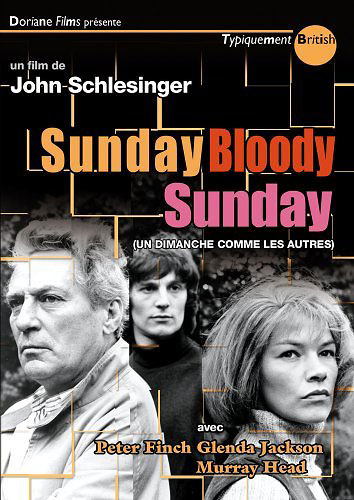
     Then, there is a rap on the window, and it is Gretchen and the two Johns, her friend and her (lovely) cousin, wanting to know if I want to go to a movie. They are thinking about something called Sunday, Bloody Sunday, which they seem to think I’ve heard of — and I think I should have heard of it — but I haven’t. But it’s directed by John Schlesinger, who directed Midnight Cowboy, so I decide to go.
     But it is not the same. There are too many telephones ringing too loudly, too much cutting between scenes. I assume the way they, the scenes, are juxtaposed, the juxtapositions must mean something (like rhymes and half rhymes and all the different ways of rhyming — alliteration and assonance and anaphora and all — should mean in a poem; but I don’t see it: dinner with parents, charades, the enthronement of the boy/man at his bar mitzvah, the death of a dog hit by a potato truck (and mourned for 40 seconds), another phone ringing, lots of smoking. About an  hour and a half in, we see the young man — but I didn’t say this yet, did I? At the center of it is a vapid young man, played by nobody I’ve ever seen, shared by Peter Finch, as a gay Jewish doctor, and Glenda Jackson, with eyes as green as a cat’s and perfectly arched eyebrows; but you can’t figure out why either cares for him. So, when we see him at a TWA counter, presumably buying a trip to the United States, though there must have been half an hour of film to go, I left, because I was glad he was leaving, and I didn’t want to see anybody sorry he was.
    Then, when I got outside, and it was showering again, I thought that might be the point — this was not a movie without a point: that people can love other people that are not much at all; and most of us aren’t, are we? The thought didn’t make me go back into the theater, though.
     Instead, I came home again. I sat back down at my kitchen table; and I wrote this to you (among other reasons to say if you have any say in the choice of movies, make better selections). You are welcome for the long letter. Write me back when you can.
                                                                                                               Love, Moira

 Have you lost interest in the living?” Axel said. “Is your sister writing your blog now?” Uncle Albert asked.
     “It may seem so” I said. “But what do I have to write about, hardly going out and then only to the same places I always go, seeing the same people I always see. But mostly I am sitting in with you, reading old books, or paragraphs of old books between staring out the window and wandering from room to room?”
     “I see your point,” Uncle Albert said. And he turned and wobbled silently away. Silently, on his three uneven legs, he shimmered out. 
 
                                                                          09.02.23


Tuesday, August 22, 2023

Little green heron

 Little green heron 

I played golf yesterday, the first time in at least a year — at least a year since I’d held a club in my hands. It is such a bizarre concept, hitting a ball with a crooked stick across fields, hoping to find a hole it will fit in.
     The origins of the game must be something like that: spheroid, crooked stick, fields, hole. A shepherd hitting frozen sheep turds with his crook until he lodges one back in one of the sheep. Practice. Then, he comes on another shepherd: “Watch this!” “Wait! I’ve got to try that.”

We no longer live in the Scottish hills of that far-off, innocent time. We live under bustling Western Capitalism run amok. So games’ origins must be scraped away so associations can rise up to organize them, industries to supply them. Consider the evolution of the baseball mitt from a pancake to protect the hand to a Venus flytrap the size of a rhino’s head. Consider how in golf not only does a sheep turd become gutta percha become balata become Surlyn but hickory will become steel will become sixteen different grades of glass, and two legs will become four wheels with a motor.

I shot 90 from the so-called senior tees, which I allowed myself as I was afraid to swing more than a 4-iron given the state of my lower back, even fortified by 600 mg of Ibuprofen.
     I started with a seven on the opening par-5, but then I had three pars in a row, and I thought I might know what I was doing. I didn’t. I hit the ball well all day and still shot 90.
    But the course we played, near Luray, is nestled into the Blue Ridge, and there were some lovely views — the close-mowed meadows of the fairways bumping into the mountains, the mountains bumping into a sky like a shell, the way it is in Genesis 1, the firm-ament.

I used to like playing golf, a kid with other kids, humping seven clubs around the shaggy course in Beeburg (where Uncle Darrow made part of his living), trying to make the ball move in different directions without cutting it. Sometimes, running between shots, we’d play nine in less than an hour, less than forty-five minutes! Then, we would lie on our stomachs in the grass by the first tee to look down at the girls lying by the pool on their towels in swimsuits like tropical birds. Summer, we were sure, would not end this year.
      Hard to remember. Our round cost us four hours (with motor).

A typical golf shot, from the time you take the club head away from the ball until the time you strike it, must be at most a second-and-a-half. So, out of 240 minutes, you’re actually playing about two-and-a-quarter minutes if you shoot 90 like I did. (Those that have claimed that golf is better than sex, incidentally: what does that say about them?)
     Anyway, I made it through eighteen holes without minimal embarrassment.

The highlight of the round: We may have seen a green heron, but we couldn’t be sure. But then
     “It's hard these days to be sure of anything,” as my golfing friend Hamlin Moody (aka Jackass Jones) likes to say.*
                                                                            08.22.23 
_______________
* See here and here about the time he played with Donald Trump.

Thursday, August 17, 2023

It's been a while, but at last

 Another parable 

I continue to hear stories from Scripture as parables. For aren’t they all finally, in one way or another, about “the kingdom of God”? Especially the stories the prophets tell: They are about what God is going to do when God gets around to doing it, sometimes now, sometimes later, and sometimes already? They begin really as Jesus’ parables do, “The kingdom of God - it’s like this, isn’t it?”
     In today’s lesson, from the first chapter of Malachi, what God has already been doing — it’s hating and loving; they are inextricably linked: Our little minds cannot separate them.

Who have ears, my children, let them hear.
The parable of the Jacob and Esau according to Malachi, the prophet.
Listen: 

 You can find links to other stories from that notorious biblical paraphrase, the Ted Riich Version, by clicking here: the TRV. You can read the parable here.

                                                                           08.17.23 

Friday, August 4, 2023

Homecoming

 Homecoming 

I had seventeen emails when we got home. One was from Gaspar Stephens, one of three people that read the blog regularly, or more or less regularly: “How was your trip? I thought you’d be writing about it?”
     “I might have been,” I wrote back, “but my laptop wasn’t working. But I will. Soon.”

Lebanon water tower, but in Missouri,
so not the one John fell from.
I also had a letter from Moira I talked to Dr. Feight about. She had gone to a movie with her friend Gretchen Moore and Gretchen’s friend John and Gretchen’s cousin John. Both Johns died young; both died in 1970, Friend John, just graduated from Carleton College in Minnesota, by stepping on a land mine in Vietnam, and Cousin John in a drunken fall from a water tower between his sophomore and junior years at Emory & Henry. He was visiting a classmate in Illinois, the son of a Methodist minister. He died on the third day, and, according to Moira, “He remains a young and callow fellow but extremely handsome — almost as handsome, though not nearly as pretty, as Jon Voight in Midnight Cowboy, the movie we saw.
      “You wouldn't imagine it would be shown here, would you? Not only because it is about male prostitution and grinding, not humble and uplifting poverty (like Naomi and Ruth’s or Mary and Joseph’s), but because it is the saddest damn movie ever made, at least that I’ve seen. And it’s sad because love doesn’t redeem anything at all, and hope leads exactly nowhere. So, to paraphrase The Apostle (as you call him), ‘Death on a bus, hope, and love; and the greatest of these is death on a bus.’
     “We went for coffee after the movie, but only your high-school buddy Phil Allingham was there, watching a baseball game. He’d never seen the movie, he said, and he
’d never wanted to. Gretchen replied that she’d never seen a baseball game or ever wanted to. Phil didn’t care; he only turned back to watching his. Plus, I think she was lying.
     “Her friend John said after we sat down that he didn’t much like it — it was too grim. Hadn’t he died, ‘and gone to heaven,’ he added with a grin, ‘to escape such sordidness or, more to the point, to see how it had been redeemed?’ He didn’t want to be reminded that it hadn’t.
     “‘It’
s where the Christian faith fails, isn’t it?’ he said. ‘Christ has died to redeem the world, but it hasn’t changed a whit. People cannot escape the messes they have gotten themselves into. Or, if they do, it isn’t by the grace of God but either by dumb luck or because they know someone with money or influence or, more likely, both.’
     “‘If you had gone to Harvard instead of Carleton,’ Gretchen said, ‘you wouldn’t have died in Vietnam.’
     “‘I’d never have gone to Harvard,’ John answered.
     “‘Me neither,’ John the cousin said. ‘I was lucky to get into Emory.’
     “Afterward, Gretchen went away with her friend John, and her cousin John said he would walk me home if I liked. A worldly gesture — no need for it here — but I said, ‘Sure,’ he was so good to look at even if not as pretty as Jon Voight in the movie. He was about as bright as Joe Buck though, I would add if I weren’t obliged always to be kind.”

There is a P.S.: “Is Gretchen’s friend John right about the Christian faith, that it promises redemption but doesn’t truly deliver? Or maybe it just hasn’t delivered yet? That’s one theme in the New Testament, right? — Christ will come again and reverse every ill, and there will be peace and no more tears?
     “What do you think?”

“So, what do you respond?” Dr. Feight said softly after I had lapsed into silence. The silence must either have lasted or have been “pregnant,” because he seldom speaks. When he does, it is softly, as if he doesn’t want to wake me if I have fallen asleep. But I hadn’t. Still, I waited. Sometimes, probably out of sheer cussedness, you want people to have to wait with you.
     “I was going to ask Axel — Axel Sundstrøm — what he thought,” I said. “Or Uncle Albert. But I decided not to.”
     “Oh?”
     “What I think?”
     He didn’t say anything more, which I took to mean “yes.” Or he was making me wait,which I didn’t.
     “My first thought was that we had never given redemption a chance. We couldn’t embrace Jesus — love and peace and healing, and concern for the poor and oppressed — at least not so that we were willing to give up wealth and power, all wealth and power. And pride. All pride.

     “Then I thought, though this is much the same thing: ‘Whose fault is that?’ Christ could not redeem the world because in Jesus of Nazareth God came not in power but in weakness, and the world could never embrace that. The few followers that did maybe were soon pushed aside by those that knew better. You don’t get on in the world without organizing, and you can’t organize without a hierarchy, a power structure. Power, then, cannot be truly shared, much less no-power — what is that anyway? And before long, the Jerusalem disciples would claim a monopoly on baptism by the spirit, Peter is judging Ananias and Sapphira, and Paul is judging everyone, including Peter, never mind that he is going to be the first Pope at Rome.
     “Then, I was thinking, ‘Who was the second?’”
     “Linus,” Dr. Feight said. Softly.

                                                                         08.04.23